I just noticed, and it’s a bit of an obvious reach, but every time he killed for the Dark Side, he used his own saber. But when he killed Snoke to save Rey (canon), which is Light af, he used Anakin’s saber.
No, I think you may be onto something. He even finishes the praetorian guard battle with Anakin’s saber.
@loneamidala That’s not a reach, it’s pretty blatantly significant that he killed his abuser/saved Rey’s life with that particular saber. Especially since it’s the same saber that WOULDN’T go to him on Starkiller. But as of TLJ, the Force (and/or even Anakin himself) has deemed Ben more worthy of it.
THIS^
Omg yes I never thought of it that way
Wow. Why did I never put this together?
So apparently, most people did not previouslyrealize or take into account the implications of Ben being able to handle Ani’s saber in TLJ, when he very pointedly couldn’t in TFA. I was wondering why more people weren’t discussing that, even though I see it as one of the most significant developments of the movie and Ben’s arc.
Reylo shippers always talk about how the saber wouldn’t automatically go to Rey, or either of them, this time when they were tug-of-warring over it, but no one really talks about the fact that Ben was able to hold it, and telekinetically manipulate it, and catch it from Rey in the first place.
The point at which I realized this was important for Ben wasn’t even that he could use the saber, but more that it refused to choose Rey over him during their tug of war in the throne room. It barely responds to him in TFA but then is so torn between him and Rey that it splits in two? Yeah that’s highly significant.
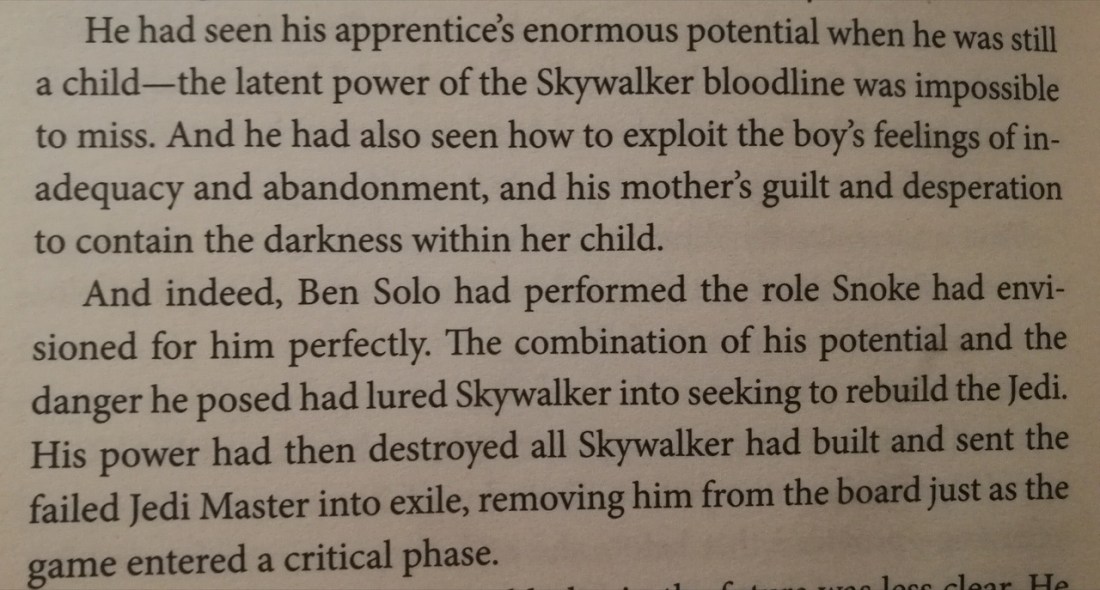
Here’s a passage from the last jedi novelization where snoke confirms outright that he had been manipulating ben by exploiting his fear of inadequacy and abandonment since he was a child.
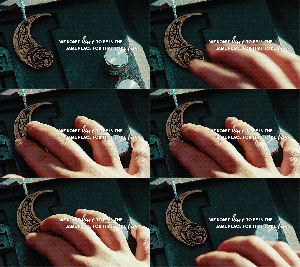
“Paige had her own Otomok medallion wrapped around the gunsight mount of the cannon, as she often did, but now she untied it and hung it back around her neck, the way Rose was wearing hers.” ↳ Star Wars: The Last – Cobalt Squadron by Elizabeth Wein
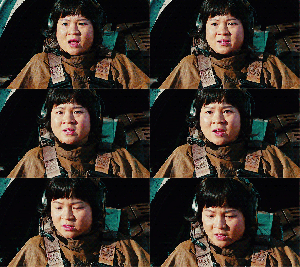
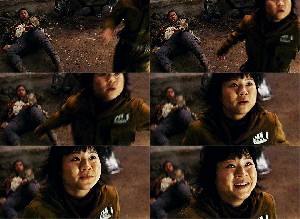
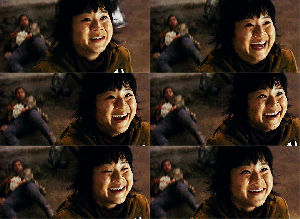
you guys wanna know why she makes this face when she sees the fathiers up close? u really wanna know
their homeworld had no animals at all, but Paige loved to play and fantasize about animals and filled their room with pictures, and Rose got really into it too
and Paige’s professed favorite animal was the fathier and she really wanted to ride one
so with that, I think the whole fathier escape can be read as Rose memorializing her sister
yes…there it is. you have too much of your father’s heart in you, young Solo.
omg someone hug him pls
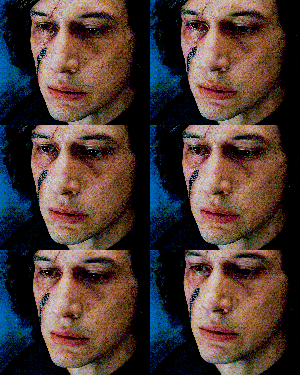
I have so many emotions about the gesture. His chin’s up but his eyes are down. There’s shame, regret, probably fear, but he’s not bowing his head. Even after being derided and struck with lightning he’s got his head up. It’s that little spark of defiance. He’s not been completely broken and he never will be because even after all the emotional and physical pain brought on him by himself and others, he’s still stubborn enough to hang on to just a pride. Too much of his father’s heart, indeed.
I know I am not the only person who picked up on the musical similarities between John Williams’ beautiful theme for the character of Rose Tico, and Beethoven’s magnum opus, the Ode to Joy from his Ninth Symphony.
The rhythm is different, with Rose’s Theme using sixteenth notes instead of 8th notes, but the melodic material is very reminiscent. Check it out: 2nd of the scale moving to 3rd, then 4th, back to 3rd and down a major 3rd leap. It struck me as a delightful little reference/ear worm, and it got me thinking about what this particular symphony represents in our culture, and what Rose represents for the larger narrative of the saga films.
“Sachs notes that while Beethoven was hammering out drafts of the symphony on his legless piano, other artists were toying with similar themes of individual striving—a strain of what eventually came to be identified as Romanticism. The works of Byron, Pushkin, and Beethoven, Sachs writes, were subtly linked by this “hidden thread” of expressing in art a “quest for freedom: political freedom, from the repressive conditions that then dominated Europe, and freedom of expression, certainly, but above all freedom of the mind and spirit.”
One thing that Rose and Paige Tico absolutely represent is this: the people Holdo mentions when she gives her inspirational speech after assuming command of the Raddus. “In every corner of the galaxy the downtrodden and oppressed know our symbol and they put their hope in it. We are the spark that will light the fire that will restore the Republic.” These two sisters believed in that symbol and that hope so strongly that they were willing to join the Resistance and put their lives on the line, and in Paige’s case, ultimately give that most final of sacrifices. They learned from the fate of their home system that the repressive conditions of the First Order had to be resisted, just as the repressive conditions of the Empire had to be rebelled against. They were both fully committed to restoring peace, justice, and freedom to the galaxy – and of course I can’t peer directly into the minds of John Williams and Rian Johnson, but I cannot see this connection being mere coincidence.
“More specifically, the prelude to the “Ode to Joy” from the fourth movement of Beethoven’s Ninth Symphony was adopted as the Anthem of Europe by the Council of Europe in 1972 (and subsequently the European Community and the European Union) in order to celebrate the shared values of the member states and express the ideals of a united Europe: freedom, peace, and solidarity.
Furthermore, Beethoven’s “Ode to Joy” has served as a musical backdrop to major socio-political developments both within and outside Europe over the years. It has been used as a protest anthem from demonstrators in Chile who sang a version of the famous tune called El Himno de la Alegria (“A Song of Joy”) during protests against the Pinochet dictatorship and Chinese student broadcasts at Tiananmen Square to the more recent Occupy Wall Street–driven gatherings in Madrid and elsewhere. During Christmas 1989, Leonard Bernstein conducted a version of Beethoven’s Ninth Symphony at the Brandenburg Gate to celebrate the fall of the Berlin Wall. In November 2014, the Berlin State Orchestra under Daniel Barenboim would again perform Beethoven’s Ninth in front of the Brandenburg Gate to mark the 25th anniversary of the fall of the Berlin Wall.
Rarely has a musical composition captured the imagination, hopes and aspirations of so many people, from such diverse and different backgrounds. It is exactly this that makes the “Ode to Joy” so special and indeed emblematic of the universal longing for happiness and brotherhood. From the Americas to Europe, Asia (the Ninth Symphony is traditionally performed throughout Japan at the end of each year), and the rest of the world, Beethoven’s music and Schiller’s words have been the carriers of a universal message that manages to transcend the boundaries of time and culture.”
How powerful it is that the musical leitmotif given to this character can really be extrapolated to represent the hopes and dreams of everyone in the galaxy! There’s also another layer of meaning when it comes to Rose’s personality – it’s obvious there is a deep wellspring of joy within her, a natural optimism and ability to see wonder in the world.
How powerful it is indeed, also, that Rose is one of the main catalysts to Finn’s growth. That her strong moral sense of what’s right and wrong, and her full commitment to restoring freedom and justice to the galaxy, help him find his way and his true place in the world.
One last note on this: another quote from The Atlantic article gave me the tingles in terms of The Last Jedi as a film and what it really means.
“All would perhaps agree with one thing: Taruskin’s assertion that the symphony means something, but that nobody can “claim to have arrived at a definitive interpretation.”
Which is at once a frightening and wonderful state of affairs. Unlike, say, Shakespeare’s Hamlet, Beethoven’s masterpiece authentically can and perhaps should mean something personal and different to everyone who approaches it, standing for whatever we view as the best, strongest, and most exalted about humanity. As Wilhelm Furtwängler—one of the best conductors of the symphony—once said, trying to nail down Beethoven’s ideas any more precisely than that is like stabbing a butterfly to an entomologist’s wall.
Sachs himself admits this prior to his admirable, “highly personal” analysis of the Ninth: “there is one inescapable fact”: the symphony “belongs to each person who… attempts to listen to it attentively.” We may never agree what it means, but, as with an eclipse, all we can do is approach it indirectly with caution, humility, and wonder.”
This is why it’s hard for me to debate with people who didn’t like The Last Jedi, for whatever reasons they want to give. This is what TLJ means to me; it is a piece of art that held a profound mirror up to my innermost workings and made me gasp with recognition. The lessons we learn from it, to me, truly fit into those things that are the best, strongest and most exalted about humanity – the lessons of hope, forgiveness, connection, the commitments to justice and freedom, the acceptance and necessity of failure, the fact that you cannot banish the past completely, nor can you live in it forever. Beethoven’s 9th, to me, has always been a glorious declaration of the fortitude and resilience of the human spirit. I absolutely LOVE that this musical composition and everything it stands for is echoed in the theme given to Rose Tico, a strong female character with no special Force powers or lineage – just an unshaken belief in what’s right and a commitment to see it through. Just the wisdom to know that they’re gonna win, not by destroying what they hate – but saving what they love.











 This is Not a Blog