When will people talk more about how Snoke literally admitted that he ruined Hanleia happy ending by dealing them a death blow of practically stealing their son? Just for getting back at Luke and ruining his plans and his work as a jedi??
Are we? ?
Because i am tired of people blaming Kylo ,of all people ,for “ruining everything” when that evil raisin is right there!
He admitted he stroked Ben’s conflicts artificially so Luke has to create a Jedi order to help his nephew. And eventually “confront” him so he flips out on him too because of this.
Its his lackies and a senator secretly working for his organization which exposed Leia and Luke’s parentage secret to everyone when Ben was 23 ish. Which forced Leia to form a rebellion without legal support . And a Galaxy which would never believe Ben Solo if he said “his jedi master tried to kill him” after they hear news of burned temple+Vader reveal. Which leaves Ben with few options but Snoke to go to. (<- honestly, the timing is just too coincidental to not use the reveal to isolate Ben from society)
He ordered, specifically Ordered Kylo to kill Han otherwise he would be never “free of this pain”. For Kylo , thanks to Snoke’s gaslighting, his conscious choices are either live with this psycho-spiritual pain of conflict his entire life and suffer or kill his father he loves. Subconsciously, its either kill his father or die himself because lets be real here, outside the scope of fanfic there is no way Snoke would let Ben live the moment he decided to leave him. He is right inside his head! -“so lonely, so afraid to leave”. We know abusers don’t operate like that (makes me think the theory of him killing all KoR at some point might be one of the viable ones to keep Kylo psychologically locked)
Snoke ruined everything .
Solo-Skywalkers might still have been a dysfunctional mess but they were somewhat functional before Snoke pushed the right buttons and disintegrated the family we loved and the Galaxy(dysfunctional but working kust like skywalkers!)
Snoke is literally the on-screen equivalent of the stereotypical misogynist ’fanboi’ with his gold Hugh Hefner robes and stupid slippers. He doesn’t think Rey is a good hero and is weak and he’s constantly disappointed that Ben/Kylo isn’t as ‘badass’ as his grandfather, yet he himself sought Ben out like he was a super rare Pokemon card or some shit.
Not to mention that he was SUPER overpowered in his Force abilities, but didn’t put any points in his Charisma or Intuition category, (otherwise he would have seen Kylo’s betrayal coming, amirite?)
I mean, SHIT, he probably has some stupid ass Gamertag™️ like **MAGAVaderf@n6969** and uses fucking cheat codes on multiplayer.
Literally, Snoke is a walking pile of shit who wrecked the Star Wars because he didn’t like the direction the Skywalker family was going in.
Alright, y’all want a rundown of what exile looks like in Star Wars? Cuz this is exile in Star Wars, and it ain’t pretty, or nice, or good. Nor is it meant to be:
Yoda
“Failed, I have. Into exile, I must go.“ –Revenge of the Sith
“Perhaps the Empire thought he was long dead and had ceased searching. Or, more likely, the Empire did not care, so unimportant one ancient Jedi Master had become.
He sighed again. Maybe the Empire was right. About how unimportant he had become, that was.”
“Their exile had been too long and too lonely. But had the two of them remained together, the Empire would surely have found them.”
“For Yoda, the galaxy was so rapidly becoming emptier and emptier.”
“He held back the loneliness. He held back a galaxy without Obi-Wan.”
“And he whispered to himself, ‘Mourn them do not. Miss them do not. Rejoice for those who transform into the Force.’
But he was lonely.
‘Train yourself to let go of everything you fear to lose.’
But he was lonely, and old.
And he had failed.
He had not seen the paths the young Padawan Anakin had begun to take."
–“There Is Another”, From A Certain Point Of View
Ahsoka
"She was alone, something she was never meant to be. Her people were tribal…and her ability to use the Force gave her a galaxy of brethren from all species. Even after she left the Jedi Temple, she could feel the others when she wanted to–the ebb and flow of them in the Force around her.
Until, of course, she couldn’t.”
“…the yawning gulf that had haunted her since Order 66.”
“…there was a darkness to her meditations now that she didn’t like. …The familiar presence of Anakin was gone… Ahsoka couldn’t feel him anymore, or any of the others. Even the sense of the Jedi as a whole was gone… She missed it like she would have missed a limb.”
“She felt the familiar tightness in her throat, the same strangling grief that came every time she imagined what had happened when the clone troopers turned.”
“Ahsoka found herself spiraling down through her grief and reached out to grasp onto something, anything, to remind her of the light.”
“The Jedi were gone. Ahsoka thought it mercilessly, over and over again–still too afraid to say the words out loud–until she could take the final step: the Jedi were dead. All of them. …They were dead, and there was nothing Ahsoka could do.
Why had it been her? She’d had that thought a hundred times since Order 66. Why had she survived? She wasn’t the most powerful; she wasn’t even a Jedi Knight, and yet she was still alive when so many others had died. She asked the question so often because she knew the answer. She just hated facing it, as painful as it was. She’d survived because she had left. …She walked away from the Jedi…and because of that she was alive, whether she deserved to be or not.” –Ahsoka
Obi-Wan
“Bail thought of Obi-Wan, sitting by himself on some Outer Rim world. His sacrifice was to take himself out of the way, to focus only on the future and not give any thought to the present. It would be a lonely way to live, even if it was peaceful, and Bail did not envy him at all.”
“He’d gone to Shmi Skywalker’s grave to apologize for losing her son. He had never met her…but Qui-Gon had made her a promise and Obi-Wan hadn’t been able to keep it. As he stood there, looking at the stone, he felt an even deeper shame.” –Ahsoka
"‘For nearly two decades, I have been little more than a shadow waiting to become a Jedi Knight again.’"
"Only after Anakin’s fall did [Qui-Gon] push himself to appear fully. …This he did for Obi-Wan; at least his Padawan did not have to spend his years in the desert entirely alone."
"But after all his losses, all his sacrifices, all these endless years in the desert, Obi-Wan Kenobi still wants more life." –"Master and Apprentice”, FACPOV
“Nineteen years. Nineteen years since I left him to die. Nineteen years of reliving his corruption every night in my dreams.” –“Time of Death”, FACPOV (Obi-Wan was having recurring, depressing ptsd dreams about Anakin during his entire exile, y’all)
Luke
“I see things that are not yet to be. …worst of all, Luke, as I am now, an old man, his face creased, his eyes haunted. He’s cut off from those who love him, consumed by regret and sorrow. It is too much to bear, a future I never want to see." –"Time of Death”, FACPOV
“’Do you think I don’t know my friends are suffering? Or that I came to the most unfindable place in the galaxy for no reason at all?’”
“He wondered what that Luke Skywalker would think of what he’d become.”
“…whatever had happened to him had led him to reject his own legacy as well. Not for the first time, she wondered if he had slipped into madness during his years in exile.
But the bearded man in the rough-hewn woolens didn’t look insane. Just profoundly sad.”
“Rey wondered if he relived those dark times every day, brooding on top of the island as when she’d first met him, or if he never did–if it was her arrival that had forced him to confront the events that had caused him to shut himself away from family and friends and vanish."
“‘…it was I who broke that family. I failed. Because I was Luke Skywalker, Jedi Master. A legend.’
He said that last word as if it were something terrible–a burden and a curse.”
“…a broken man dragged back into a storm he’d thought he’d escaped.” –The Last Jedi novelization
“And I was left with shame and with consequence.”
"I came to this island to die." –The Last Jedi
******************************
Exile in Star Wars is grief, shame, anguish, guilt, survivor’s guilt, and intense loneliness. Exile in Star Wars (and in general, really) isn’t a salvation, it’s a penance. And Ben Solo is already paying the penance for his own sins, and his grandfather’s, and the fatal mistakes of his Jedi forebears that have been reverberating throughout his family and the galaxy for decades. Which is why one of the purposes of this trilogy is to make it clear that, finally, enough is enough.
If I had more time and energy, I’d write meta about Star Wars, but I never seem to have the time, energy, or really the audience for it.
A thought that’s been on my mind recently is the metanarrative of Star Wars and how we’ve gotten so damn cynical. TLJ kind of seems to feed into this a bit (on the surface it rejects legacy, rejects the whole plot of Poe being a Hot Shot With A Plan So Crazy It Just Might Work, and Ben’s whole everything) but it really doesn’t. TLJ rejects the idea that legacy is the only thing that matters, even pointing out through Luke that sometimes it can go to your head and cloud your judgement, but ends with Han’s dice as, in my opinion, a reminder that what parts of family (Or cultural or w/e) heritage you uphold are up to you. Poe’s story is a warning against arrogance. Ben himself is a call back to every important character in the saga and when he’s not leaning on the fourth wall he’s kind of a symbol for all of this – his darkness and his fate is the symbolic darkness and fate of everyone who came before.
But all that aside, the historical context these stories are present in puts an odd weight on the story. The conversations around the story shapes the interpretations of the story and these characters in a very strange way that’s both disheartening and fascinating.
Omg, I got the most amazing answer!
I believe that by the end of IX what we’ll get will be a “redemption of legacy”, which is why the second film appears so cynical. It’s a fatal flaw to rely too heavily on a legacy but to “kill the past” is equally as flawed. A reconciliation of past and future is where we are heading imo.
I feel you completely in what you say, the historical context in which the ST takes place is heavily loaded in that regard, so the movies end up being under an odd light to say the least. But SW has always been its own thing. I think that Lucas was a man “outside” of his time in the way he chose to tell his story, as a myth, and I believe the new direction of LF stuck to the core of what SW always was.
Once again, I LOVEEEED your answer (and I consider it to be a meta).
Thank you! And now that I’m not just kinda wildly posting and hoping it sticks, I’ll expand a little lol.
I absolutely agree. The universe is trying to set up a compromise between honoring the past and letting go of the things you don’t need/the things that hold you back. Doing both is necessary in order to move forward both individually and as a society. We have to learn from the past, to understand our mistakes, and to let go of the guilt, shame, and fear that those mistakes cause us if we ever want to move forward. This is exactly what Luke learned in TLJ and what he is attempting to pass on to both Rey and Ben. The movie seems cynical on the surface, what with the whole “it’s time for the Jedi to end” “let the past die; kill it if you have to” kind of talk but that argument doesn’t stick where it counts. By the end of the film Luke has gone from “it’s time for the Jedi to end” to “I will not be the last Jedi” because he’s finally understood that failure is an important stepping stone instead of a dead weight.
And honestly, the reconciliation of the past and future is needed. Vader’s shadow is heavy over the whole trilogy because the man and monster were never reconciled. Anakin kind of got an easy out by dying, honestly. Everyone else had to come up with a way to make sense of the fact that the galaxy’s favorite soldier was also it’s greatest terror and ultimately they couldn’t do that. That’s really the whole reason we have a conflict right now. In a way, Anakin’s redemption isn’t complete. His legacy needs to be one that affirms, not damns, or else what had he done but left ashes in his wake? And that’s the point, imo.
As to the metanarrative, it’s so interesting because Star War is a myth. It exists in a timeless way where the core themes and ideals of the story can be used to teach and advise even out of their original context. But that’s not to say Star Wars isn’t political. It absolutely is and always has been. Lucas himself admits that the OT was his own version of protest against the Vietnam War and the Emperor is both Nixon and Dick Chaney depending on what trilogy you’re watching. So while I do believe the ST is political, I don’t think t’s political in the sense that what we’re seeing on screen is supposed to match what we’re seeing IRL. If memory serves, The Force Awakens was written in 2013 which was before *gestures to everything* this. Five years ago we had different concerns. Concerns like “what about war profiteering?” (Canto Bight) and “should we really be using drones to kill people super far away?” (Starkiller Base) and “are we really just paying for the short-sighted mistakes of our past because honestly a lot of this is hangover from older conflicts?” (the whole damn First Order). So yes, I think there is a political message in the ST but I don’t think it’s the thing Americans are currently dealing with. To me, it makes more sense as a reflection of the evils of the Military Industrial Complex and “It’s technically not an Empire” American Imperialism.
I think a lot of what the story was trying to say got lost because people frankly jumped the gun and decided they knew what the trilogy was about before it even hit theaters. There’s an element I can trace all the way back to g@mer g@te of internet shitlords manufacturing outrage over Finn and Rey and no white men and blah blah blah “muh Star Wars” and there’s an element that reacted to that by embracing the idea that this trilogy was supposed to be a criticism of toxic masculinity and a celebratory dismantling of the patriarchy. And honestly? Both of those miss the point and do so badly. The films don’t say anything like that. The films are a lot more interested in the concept of “how do we become what we were meant to be despite the trauma of the past” which ties in to both the character arcs of Finn, Rey, and Ben, and the political message as I see it.
Rey Killed Her Parents — Just One of My Crazy Star Wars Theories
Hey everybody, I don’t do this too often, but I love the new Star Wars movies so much that I’m coming up with all kinds of crazy speculations for the trilogy and 9th movie, much like I did with X-files back in the 90s. Now I’m not the first person to have theorized that Rey killed her parents — which I find oddly reassuring–but I’d like to add my own process as to how I came to this fun little tinfoil theory with some visual cues from the films.
So how did I come to the theory that Rey is responsible for her nobody parents never coming back?
The Force Awakens
Well, it goes back to something I first noticed back on my second viewing of The Force Awakens a few years ago. I would not really come to the conclusion that Rey destroyed her parents at that time, but I did notice something that seemed too significant to ignore.
Namely it’s this:
In Rey’s force vision, in which she sees scenes from the past and future, she stands outside of herself as a young girl, arm held tightly by Unkar Plutt [likely why she has an aversion to having her hand held by the way]. As her family’s craft leaves her behind, ascending to the sky, she cries out pleading with them to come back.
But this particular vision of the craft ends strangely. As the ship ascends, the sky turns an ominous red. And take note of that, because in Star Wars red lighting is often used to denote something evil or dark afoot.
Later towards the end of the film, we will see this darkening of the sky and subsequent red lighting again. We will see it when Kylo Ren kills his father immediately after the Star Killer base planet begins to implode. From Abram’s commentary on this scene, Kylo Ren is entirely conflicted just prior to this darkening of the sky, and up untill that point he is truly thinking of leaving with his father. When the sky darkens, the lighting on Kylo Ren’s face changes from blue to red, and it signifies an abrupt change to evil/darkness. He immediately kills his father, an act he regrets intensely upon its conclusion.
Now, at the time, I only noted that the darkening sky in Rey’s vision was a parallel to the darkening sky above Star Killer base. I knew it was intended to be significant, but I was unclear as to how. It could have meant nothing more in Rey’s vision than a foreshadowing of Kylo’s patricidal act, a blending of timelines. But why cast that dark red shadow on both scenes? A dark red shadow that is specifically intended to symbolize the dark side?
This is where the Last Jedi comes in, and where I started drawing my theory.
The Last Jedi
In the throne room of the recently deceased Snoke, Kylo Ren makes his famous plea to Rey to join him in creating a New Order. Desperate to get her on his side, to “let go of the past”, he encourages her to remember her parents, something that she has been actively repressing for years.
Rey admits they were nobody. Kylo Ren, who so far has never been deceitful to Rey (and Rian Johnson the director backs this up), clarifies further her own memories that he saw back during their force bond in the hut. They were drunks, junk traders, who sold her for drinking money. Rey does not deny this and her face shows an unhappy acceptance.
But where it gets interesting is this: Kylo also says her parents are dead, buried in a pauper’s grave in the desert.
Now many fans have thought this a discrepancy from what Rey’s vision in the Force Awakens showed us.
But I don’t think that it is, and I certainly did not think it was in the movie as I watched it.
It’s entirely possible that Rey’s vision of her parents leaving were a fabrication in her mind. After all, Rey is an unreliable narrator of her own life, and created the fiction of her parents coming back as a way to rationalize her abandonment and the notion her parents did not want her. If she believed her parents were “somebody”, a great Jedi hero, a warrior, she could fantasize that they HAD to leave her for heroic reasons, and thus it would mean she was loved, and they would come back.
However, I find the idea that her vision of the abandoning ship being a fabrication to be unlikely. The Force does not create deceitful visions.
Thus, Rey’s parents did leave her.
But how did they wind up dead in graves on Jakku? Why are we told this?
This is where the Force Awakens vision and red sky comes back into play.
Just as the darkening sky and red light immediately preceded the violent action of Kylo Ren killing his father–a sudden, impulsive act–this image of the same red light symbolizes a dark act immediately after the ship’s ascension into the sky.
That act is Rey, a child powerful in the Force, unintentionally killing her parents by bringing down their ship, in a naive attempt to bring them back to her.
This is why she remembers being abandoned, and why Kylo Ren has seen their graves in her mind. Rey’s parents never got to leave, and furthermore, she remembers them being dead. I can imagine that this would be such a traumatic act that she blocks it out, and over time creates her comforting myth that someday they’ll return for her, that she was never a bad girl who hurts people, a girl that gets abandoned for being bad.
Now, obviously, this is just a theory of mine, and some other folks on Reddit and Tumblr. But it’s cool to see others have arrived at the same minor theory on their own as well.
There’s no telling if it is remotely true until the 9th movie comes out December 2019, but if it is, it has some interesting implications for her character.
It becomes yet another parallel to Kylo Ren. These characters are both mirrors of one another in several ways–they feel abandoned by everyone around them, they are intensely lonely (even Rey, when surrounded by her new Resistance friends, comes off to me as standing a part from them), and possibly, they have both killed parents.
Ben Solo is a character that has been described as “coming from the light [eg, has good, heroic parents]” but is putting on the dark persona of Kylo Ren. Nonetheless, he is drawn to the light, both in himself, and in the person of Rey.
If Rey is a mirror of Ben Solo/Kylo Ren, we can surmise that she “comes from the dark” but wears a persona of light. She is drawn to the dark side, something that Luke Skywalker points out repeatedly. Of course, she is also drawn to the darkness of Kylo Ren/Ben Solo.
How is Rey “from the dark”? Possibly this references her parents being good-for-nothing drunks, happy to sell their child. Going with my theory, though, it could also be that the “dark” is her darkside powers that she used to kill her parents.
Again, as much as Kylo/Ben is dark and light, so is Rey, their approaches to it are simply reversed.
And it’s not talked about much, but Rey wears a mask as much as Kylo Ren wears his metal one. It’s simply that Rey’s mask takes on the form of her la-di-dah, Pollyanna unbridled optimism. It’s a shame that people feel Rey is a dull character, because in reality she is as complex as he is, and is also fighting conflicts within herself. Through the Force bond conversations with Kylo Ren, the Last Jedi film was showing us the growing cracks in her ever-happy facade.
If Rey has killed her parents, not only will it bring about further conflict within her character for the last film, it may help to shatter some of her Jedi-like self righteousness that she tends to have. Granted, killing your parents when you are 5 years old cannot be compared to a young man in his 20s killing his father, but she will realize how intense the darkness in her can be. So far she has chosen the Light side of things easily, but I envision her having a crisis of faith in the next movie.
Ultimately, whether this theory is just tinfoil over-analyzation or something that could actually be realized, I suspect that the next film will have both Kylo Ren/Ben Solo and Rey achieving balance of Light and Dark within themselves and between each other.
Side observation–one does wonder if Kylo Ren saw in Rey’s memory that she killed her parents and not just the graves on Jakku. If he did, it would mean he chose not to tell her, either hoping she remembers on her own, or not wanting to hurt her in that moment any more than she already is.
I could see the latter being a possibility–much of his suffering has been in the perception that people think he is a monster, and he is just stepping into the role he thinks everyone has driven him into.
While Kylo Ren certainly wants Rey to stop pining after her parents in the hopes that she’ll rely only on him and no one else (he is desperate not to be alone in this scene), he doesn’t exactly want her to become so utterly despondent to believe she is a monster incapable of being loved. Hence the “You’re nothing but not to me”, but no “And you’re a murderer just like me!”
Also, Unkar Plutt must know some shit, he’s the last guy aside from Rey to have seen her parents. I get that Rey hates Plutt and does not want to talk with him any more than she has to, but I wonder if she will ever consider asking him about that deal her parents made.
Anyways, that’s my crazy tinfoil Star Wars theory. I have no idea if Rey actually killed her parents, but it’ll be interesting to see if this one pans out or not! Have you got any zany wild Star Wars speculations or theories? Post them below!
THIS IS ACTUALLY A GREAT THEORY AND I’M A BIT HYPED RIGHT NOW.
I love Rey’s arc in TLJ and I love how it’s revealed her optimism is actually a coping mechanism. She’s definitely got a Dark Side to her and that’s what makes her a relatable character.
If she did kill her parents by stepping into her Dark Side inadvertently, not only does it add to this complexity but also additionally explains why (in “Rey’s survival guide” and in “Force of destiny”) she’s such a solitary character – canonically, majority of scavengers work in groups, that’s how their daily scavenge and their chances of survival increase –
Not only that she hates being tricked and fooled again, but that poor girl is also probably afraid she might again hurt someone like that.
Not to mention that it makes Kylo/Ben an even more sympathetic character because he didn’t throw this truth to her face. He just reminded her that her parents were nothing and that she shouldn’t feel guilty about anything concerning them.
Re: Unkar Plutt knowing something… he could’ve just as well ascribed the crash of Rey’s parents’ ship to a freaky malfunction. Remember, this is a post-Jedi world where everyone (including Rey in TFA) think of the Force and Luke Skywalker as of a legend, a myth.
Damn it, fandom. There goes my life.
This theory is good and if true, heartbreaking. It would be a tragic twist to Rey’s story arc that would elevate Rey to a truly heroic character kinda ironically, because out of an unspeakably Dark act she chose to be good, even though she handled it rather unhealthily.
Hey everyone! It’s been a while since I have written a meta, and this would be the first time that my meta is focusing on the villains, rather than the hero(es). I have seen that popular post about the Stockholm Syndrome and the three characters mentioned in the title here, however, this is not a rip-off, and I am taking a different spin on the relationship. Hope you have fun reading, leave comments, and don’t be shy to message me about this or anything else! 🙂 Oh, and, I could also probably write a whole separate meta on the villains’ narcissism/dark triad, there are whole books written on the topic, but I am trying to give a brief overview of all the aspects of the relationships, and draw all the parallels I can find.
Let’s get started! 🙂
A common denominator for
Supreme Leader Snoke (Star Wars), Mother Gothel (Tangled), and Judge Claude Frollo (The Hunchback of Notre Dame) would be the dark triad.
THE DARK TRIAD
The dark triad is a subject in psychology that deals with three traits – narcissism, machiavellianism, and psychopathy. All are conceptually distinct although empirical evidence shows them to be overlapping. They all point to a callous-manipulative interpersonal style.
Narcissism is characterized by grandiosity, pride, egotism, and a lack of empathy.
Machiavellianism is characterized by manipulation and exploitation of others, a cynical disregard for morality, and a focus on self-interest and deception.
Psychopathy is characterized by continuing antisocial behavior, impulsivity, selfishness, callousness, and remorselessness.
I will elaborate on how these traits (perhaps not all of them, but most of them) manifest themselves below.
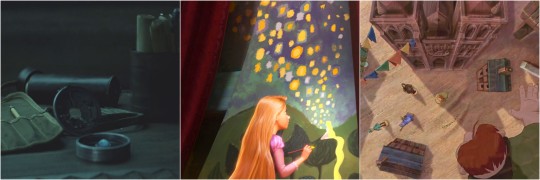
One thing that all of these villains have done to their victims (Kylo Ren/Ben Solo, Rapunzel, and Quasimodo, respectively) was separating them from their families at a young age and then keeping them in isolation, in order to achieve selfish goals.
NARCISSISM
Apart from a certain air of grandiosity, egotism, and disregard for others, it is easy to see how pride manifests itself in the three antagonists, physically. There were two studies that determined that people with dark triad traits put more effort into their appearance. All three are vain – Snoke is dressed in a gold robe and slippers, Mother Gothel captured Rapunzel in order to remain young and beautiful forever, and Frollo adorns himself with large rings (do not get me wrong – nothing wrong with large rings, I am just talking about what they represent, in the limited character exposure we get! 😉 ).
STUNTED GROWTH, EXPLOITATION
One of the defining characteristics of these relationships is that the villain does not let their victim grow – otherwise the victim would certainly run away. While this stunting refers to the intellectual and emotional,in Rapunzel’s case, this is symbolized and presented in a literal way – Rapunzel wears a dress that is several sizes too small for her body, even though Mother Gothel does not seem to have monetary issues, and makes shopping trips. When it comes to the intellectual, Rapunzel only has three books, even though she obviously enjoys reading – she does it every morning. While Quasimodo is about 20 years old, we can see him still learning (or rather – endlessly repeating) the alphabet (Frollo: D? Quasimodo: Damnation?Frollo: E? Quasimodo: Eternal damnation!). Quazimodo is bright and he could certainly do more. Snoke somewhat stunts Kylo Ren’s intellectual growth – remember Snoke’s promise about the continuation of the training in exchange for Han Solo? – but the stunting is predominantly emotional (I will talk about the emotional aspects later).
The villains all exploit the victims – Kylo and Rapunzel possess supernatural gifts (”raw, untamed force power” – of use to Snoke for ruling the known universe, and a healing/rejuvenating power, respectively). When it comes to Judge Frollo, the exploitation is more subtle – when the archdeacon insists that Frollo mustn’t kill the malformed infant on the steps of a cathedral, Frollo says that the boy might prove to be of use one day. It is also worth mentioning that he did not spare Quasimodo out of pity, but he was “afraid for his immortal soul”.
CREATIVITY
It is interesting to remark how Kylo Ren, Rapunzel, and Quasimodo are all creative people.Kylo Ren practices calligraphy in a universe where everything is digital, Rapunzel paints, cooks, makes music, knits and charts the stars, whereas Quasimodo sculpts figurines and buildings out of wood and paints them. In a way, this indicates that they are responsive to outer stimuli, that they deeply process the events and the world around them, meaning that they are more open, and more vulnerable to “input”. This makes them a perfect target.
FAMILY
Upon isolation, the villains take up the role of the protagonists’ parents. Since the protagonists are being stunted in their development, and do not have enough of a critical opinion about their “caretakers”, they still believe in their parental figures’ judgement when it comes to what they should and should not do (less so over time).
There is also a lot of guilt-tripping going on, making the victim feel like a burden – the villain’s narrative is always a variant of how the world wanted/wants to kill the victims, and rejects them, but the they saved them.
Frollo tells Quasimodo that his mother abandoned him, and that anyone other than Frollo would have drowned him, had they found him. In a Star Wars novel, it is said that Snoke used Ben Solo’s feeling of inadequacy for his own purposes. While I have no proof of it, I am guessing that Snoke told Ben Solo how his mother, Leia, too involved into politics (novels), and father, Han, who would often be absent, did not care about him, and are abandoning him. This makes the victim clutch to their abuser, as they do not wish to be left again.
It is important to mention the following:
Rapunzel is in a tower, and her parents live far away.
Quasimodo is in his “cathedral sanctuary”, his mother dead, his father probably imprisoned. However, he wants to seek belonging among the people of Paris, establish a new “family”.
Kylo Ren, on the other hand, IS surrounded by people, BUT, from what I have concluded, he is “kept” secluded, something represented in his costume too, especially in The Force Awakens, where he is completely wrapped, to the point that not even a bit of his neck is showing. I also guess that, like Vader before him, he is seen as some sort of a strange wizard that no one really wants to be friends with. Instructed by Snoke, he killed his father – additionally, the deed makes it harder for him to go back home, to the Resistance, and to old friends. Snoke wanted to kill Leia, too.
LOVE INTERESTS
All the three villains try to – literally – destroy the protagonists’ romantic/sexual interests.
They convince the protagonists that their love interest is trying to exploit them and/or that their relationship is not genuine. Ironically, in the cases of Mother Gothel and Judge Claude Frollo, I think that they even think this to be at least partially true and that they may be projecting. This also implies that, as they are the ones uncovering this “truth” about the “manipulation”, and “protecting” their victims, they are the ones to be trusted as they have the protagonists’ best interests in mind.
While they are cutting off the emotional comfort and reassurance that the love interests would provide to the victims, making it easier for the victims to stand their ground and run away, I believe that they are also trying to prevent them from physical intimacy, that would help the victim transition from the child-like-state that they are in into (sexual) maturity. The villains intentionally infantilize their victims – Snoke calls Kylo Ren a child, Frollo calls Quasimodo “boy”.
SELF-ESTEEM
Another way in which the villains manipulate their victims is through ruining their self-esteem. This leaves a deep cut in the protagonists as, their whole lives, they receive both praise and insults from that ONE person (see the first paragraph in the segment “FAMILY”), whom they have respect and a certain sort of awe for. In part, they want to prove themselves, and that’s why they obey. For example, Frollo calls Quasimodo deformed, ugly, and implies that Quasimodo is intellectually inferior. Snoke mocks Kylo Ren for being emotional, sensitive, and compassionate. Mother Gothel makes plenty of remarks about Rapunzel’s “inadequacy”, including some about her appearance. The worst part is that the abusers tell their victims that that is simply the way things are, and that they are making all of those nasty comments for the victim’s own good, so no harm would come unto them. The lack of self-esteem makes it easier for fear to be instilled.
FEAR
Fear is a “great” way to manipulate victims and further isolate them. It does not take much to instill fear into Kylo Ren after the Luke Skywalker incident. It was, after all, his own uncle, who camein the night with the intent to kill him. When it comes to Quasimodo and Rapunzel, they were fed lies about the exaggerated dangers of other people and the world their whole lives. In Quasimodo’s case, the Festival of Fool’s day incident did not help.
THE GOLDEN CHILD AND THE SCAPEGOAT
A tactic that Snoke employs, as Kylo is not completely, literally, cut-off from the world (unlike Rapunzel and Quasi) is scapegoating. This is a technique that many narcissists employ (it does not fall into the diagnostic criteria for narcissism, but it is nevertheless well known). From what was briefly shown in The Force Awakens and The Last Jedi, we can conclude that General Hux is “the golden child” and Kylo Ren is blamed for failures whenever it serves a purpose for Snoke. This again instills a feeling of guilt and inadequacy, prompting Kylo to perform “better” next time.
IMAGINARY FRIENDS
Developing imaginary friends as a support network is a testimony to the deep loneliness that the caharacters are experiencing.
It is tragic that a twenty-year-old and a thirty-year-old are turning to stone gargoyles and a melted helmet of a dead man, respectively, for advice and support. This also shows that the trust between the victims and the perpetrators is one that is not based on trust and understanding.
Commentary:
Things turned out well in the end for Quasimodo and Rapunzel, and I hope that everything will work out for Kylo Ren/Ben Solo as well. I wish to say that he is not blameless for all that has happened so far in the sequel trilogy, but I am hoping for a redemption arc, and him breaking away from his old mindset.
Thank you for reading! Again, feel free to comment! 🙂
Disclaimer: I own nothing, entertainment and educational purposes only; I do not own any of the images or characters
or, Why there’s actually way more going on in all those parallel edits of Anakin and
Ben kneeling before Palpatine and Snoke respectively than just the kneeling and
looking a hot, tormented mess
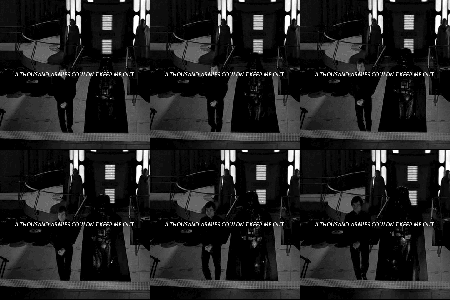
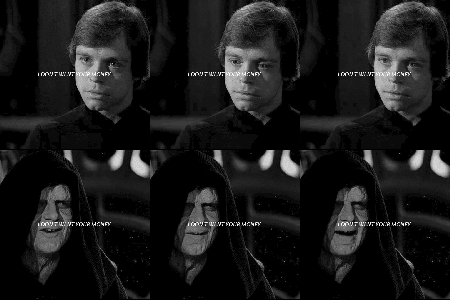
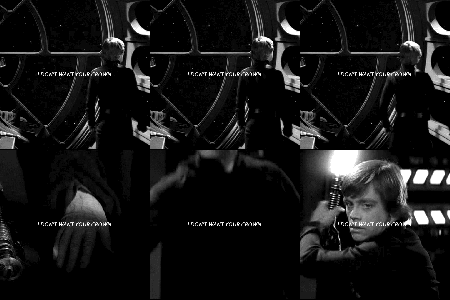
First off, for those of you not familiar with this particularly juicy bit of canon: as Ben was growing up, no one ever told him that Darth Vader is his grandfather. In fact, no one outside of Luke, Leia, and Han (possibly Chewbacca) knew that Anakin Skywalker and Darth Vader were one and the same. Ben was 23 when it became public knowledge – seven years before TFA.
Storytelling wise, this is a huge deal that I don’t think gets brought up enough. It means that Ben never knew that it was Luke’s love for his father, and in turn, Anakin’s for Luke, that helped defeat the Empire. He must have grown up thinking of Luke as the “great warrior” who defeated both Vader and the Emperor, a similar presumption apparently held by many real-life people for some reason. At least Ben has an excuse – he hasn’t seen ROTJ.
We don’t know the specifics, but presumably Ben had been fed a similar story to the one Luke grew up on his whole life. Anakin Skywalker and Darth Vader were two entirely different people, and Darth Vader was the one responsible for everything going bad, and he was defeated by Luke. Ben learns the truth eventually, and at some point, Snoke has managed to twist the story to frame it as weakness – Vader and Palpatine, the entire Empire fell because of sentiment. Hell, he may have even been able to twist it into telling Ben that Luke became as powerful as he was because he killed his father, but that’s just me speculating wildly.
First off, for those of you not familiar with this particularly juicy bit of canon: as Ben was growing up, no one ever told him that Darth Vader is his grandfather. In fact, no one outside of Luke, Leia, and Han (possibly Chewbacca) knew that Anakin Skywalker and Darth Vader were one and the same. Ben was 23 when it became public knowledge – seven years before TFA.
Storytelling wise, this is a huge deal that I don’t think gets brought up enough. It means that Ben never knew that it was Luke’s love for his father, and in turn, Anakin’s for Luke, that helped defeat the Empire. He must have grown up thinking of Luke as the “great warrior” who defeated both Vader and the Emperor, a similar presumption apparently held by many real-life people for some reason. At least Ben has an excuse – he hasn’t seen ROTJ.
We don’t know the specifics, but presumably Ben had been fed a similar story to the one Luke grew up on his whole life. Anakin Skywalker and Darth Vader were two entirely different people, and Darth Vader was the one responsible for everything going bad, and he was defeated by Luke. Ben learns the truth eventually, and at some point, Snoke has managed to twist the story to frame it as weakness – Vader and Palpatine, the entire Empire fell because of sentiment. Hell, he may have even been able to twist it into telling Ben that Luke became as powerful as he was because he killed his father, but that’s just me speculating wildly.
Can we talk about Finn for a minute? I keep reading that Finn gets described as “flat” or “boring” by some in the Star Wars fandom. Obviously everyone’s entitled to their opinion. But I’ll tell you, from my perspective? He’s one of the most unique, charismatic Star Wars characters out there.
1. Finn humanized stormtroopers. Made us experience panic and terror at the terrible choices they have to make. Stormtroopers, who were practically a joke in the other movies – white plastic statutes that existed just to get shot and clatter into a pile.
2. Finn’s flight with Poe Dameron is an explosion of emotion. That scene blew me away. Both of them had so much fun with it, and you can see Finn feel the real impact of having a name, rather than being a number.
3. Finn is profoundly empathetic and protective. Hell, I swear he cares about BB8 when he has to describe the plane crash, and Poe’s “death”, to the droid.
4. Finn shows tremendous range in this movie. Traumatized (stormtrooper battle), jocular (”you got a boyfriend?”), joyous (”that’s one hell of a pilot”), wistful (”Take care of yourself. Please.”), angry (ligthsaber battle), I could go on. I like Luke Skywalker as much as the next fan, but I think Finn shows more range in this one film than Luke did in all three.
5. Finn’s story arc is powerful, subversive, and inspiring. Going from a number to a name. Finding a family after being taken from his home as a child. Turning his back on the First Order and then realizing he needs to go further, and embrace the cause of the Resistance.
6. Finn’s relationship with Rey. I’m gonna get choked up about this, so I’ll just say John Boyega is an amazing actor, and I loved every scene he had with Daisy Ridley.
Anyway that’s my fangirling contribution. To me, Finn’s amazing.






 This is Not a Blog