LF protecting their beautiful, beautiful tortured boy.
He literally throws temper tantrums but ok it’s not that I don’t like him, he’s just literally a child
Children throw temper tantrums because they are young and due to their youth they haven’t learned how to properly express their emotions. They usually grow out of them as they mature and their capacity for processing their emotions increases. Children who are spoiled may throw tantrums in order to get their way, but spoiled adults exhibit their spoiled attitudes differently.
If an adult exhibits a pattern of tantrum-like behavior then it’s no longer due to being spoiled and it’s a medical issue usually of a psychiatric nature. Some examples are autism, intermittent explosive disorder, and intellectual disabilities. Please don’t infantilize people who struggle with explosive episodes by calling them literal children. The only literal children are people who are child aged.
If you read the article the creators of Wreck-it Ralph say they wanted to be true to the character and Lucasfilm informed them that Kylo being a spoiled child isn’t true to his character. I think it’s interesting that the TLJ novelization has Leia remember that he struggled with explosive issues as a child and now we know that the source of his issues wasnot due to being spoiled. I’m sorry if this came across as confrontational, but it’s something I feel really passionate about due to my own conditions.
I’m actually really happy that Lucasfilm isn’t perpetuating the attitude that adults with these issues are just spoiled because it really hurts those of us who are trying to manage their condition.
I’m sorry, I didn’t know that and I really didn’t mean to be offensive. I don’t think he has any psychological issues besides maybe some anger issues tho?
@aro-ace-from-outer-space22 You’re URL is awesome btw. Surprisingly enough, Kylo is actually 29 years old rather than 18. People with extreme anger issues count as a mental illness. Intermittent Explosive Disorder is this for example. According to the directors Kylo is also struggling to grow up which mentally well people don’t usually struggle with. So him coming across as young despite being well into adulthood is intentional. This is usually a sign of trauma. In the TLJ novelization Luke senses that Kylo’s rampage on Crait is more about pain and fear than anger. Luke also in the confrontation on Crait “sensed that Kylo Ren was just a shell around the same broken boy he had tried so hard to reach.” (p 297) Also this is his reaction to seeing Luke.
He has to sit down to collect himself.
“He had seen his apprentice’s enormous potential when he was still a child–the latent power of the Skywalker bloodline was impossible to miss. And he had also seen how to exploit the boy’s feelings of inadequacy and abandonment, and his mother’s guilt and desperation to contain the darkness within her child.” (TLJ novelization P 222) This passage is about Snoke manipulating Kylo since he was a child for his own uses which is child grooming and a form of child abuse. Abused children often develop anger issues and other forms of mental illness.
“It’s more than just having a ‘bad seed’ as a kid. Snoke had targeted this kid and knew that this kid was going to be incredibly powerful in the Force and wanted him as an ally.” – JJ Abrams, director of the The Force Awakens
There’s also evidence to suggest that Snoke has been manipulating Kylo since he was in the womb. These next passages are pretty long so I’m going to use the screenshots that @corseque helpfully provided us with.
Also this: “Kylo stood stone-faced as Snoke approached him, willing himself to remain still as one finger stretched for his cheek, then higher. The fingertip traced Kylo’s eyelid, leaving a streak of moisture behind.” I just…ew. Not gonna lie as a victim of abuse this really creeped me out. Snoke is evidently still abusing him.
They even filmed this scene but understandably decided not to use the footage.
(@ the person who made these gifs, thank you for the quality nightmare fuel)
It doesn’t excuse his actions, but it does explain why he has the issues he does and makes him more sympathetic.
I think even if Kylo didn’t have issues, making fun of behavior that is in adults a symptom of mental illness is pretty tasteless. That’s why I can’t stand all those “Crylo” and “Darth Tantrum” jokes.
Hey everyone! It’s been a while since I have written a meta, and this would be the first time that my meta is focusing on the villains, rather than the hero(es). I have seen that popular post about the Stockholm Syndrome and the three characters mentioned in the title here, however, this is not a rip-off, and I am taking a different spin on the relationship. Hope you have fun reading, leave comments, and don’t be shy to message me about this or anything else! 🙂 Oh, and, I could also probably write a whole separate meta on the villains’ narcissism/dark triad, there are whole books written on the topic, but I am trying to give a brief overview of all the aspects of the relationships, and draw all the parallels I can find.
Let’s get started! 🙂
A common denominator for
Supreme Leader Snoke (Star Wars), Mother Gothel (Tangled), and Judge Claude Frollo (The Hunchback of Notre Dame) would be the dark triad.
THE DARK TRIAD
The dark triad is a subject in psychology that deals with three traits – narcissism, machiavellianism, and psychopathy. All are conceptually distinct although empirical evidence shows them to be overlapping. They all point to a callous-manipulative interpersonal style.
Narcissism is characterized by grandiosity, pride, egotism, and a lack of empathy.
Machiavellianism is characterized by manipulation and exploitation of others, a cynical disregard for morality, and a focus on self-interest and deception.
Psychopathy is characterized by continuing antisocial behavior, impulsivity, selfishness, callousness, and remorselessness.
I will elaborate on how these traits (perhaps not all of them, but most of them) manifest themselves below.
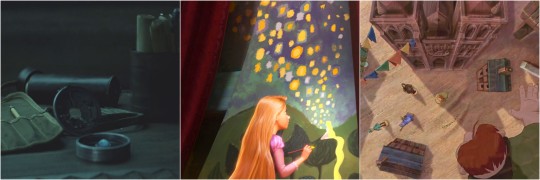
One thing that all of these villains have done to their victims (Kylo Ren/Ben Solo, Rapunzel, and Quasimodo, respectively) was separating them from their families at a young age and then keeping them in isolation, in order to achieve selfish goals.
NARCISSISM
Apart from a certain air of grandiosity, egotism, and disregard for others, it is easy to see how pride manifests itself in the three antagonists, physically. There were two studies that determined that people with dark triad traits put more effort into their appearance. All three are vain – Snoke is dressed in a gold robe and slippers, Mother Gothel captured Rapunzel in order to remain young and beautiful forever, and Frollo adorns himself with large rings (do not get me wrong – nothing wrong with large rings, I am just talking about what they represent, in the limited character exposure we get! 😉 ).
STUNTED GROWTH, EXPLOITATION
One of the defining characteristics of these relationships is that the villain does not let their victim grow – otherwise the victim would certainly run away. While this stunting refers to the intellectual and emotional,in Rapunzel’s case, this is symbolized and presented in a literal way – Rapunzel wears a dress that is several sizes too small for her body, even though Mother Gothel does not seem to have monetary issues, and makes shopping trips. When it comes to the intellectual, Rapunzel only has three books, even though she obviously enjoys reading – she does it every morning. While Quasimodo is about 20 years old, we can see him still learning (or rather – endlessly repeating) the alphabet (Frollo: D? Quasimodo: Damnation?Frollo: E? Quasimodo: Eternal damnation!). Quazimodo is bright and he could certainly do more. Snoke somewhat stunts Kylo Ren’s intellectual growth – remember Snoke’s promise about the continuation of the training in exchange for Han Solo? – but the stunting is predominantly emotional (I will talk about the emotional aspects later).
The villains all exploit the victims – Kylo and Rapunzel possess supernatural gifts (”raw, untamed force power” – of use to Snoke for ruling the known universe, and a healing/rejuvenating power, respectively). When it comes to Judge Frollo, the exploitation is more subtle – when the archdeacon insists that Frollo mustn’t kill the malformed infant on the steps of a cathedral, Frollo says that the boy might prove to be of use one day. It is also worth mentioning that he did not spare Quasimodo out of pity, but he was “afraid for his immortal soul”.
CREATIVITY
It is interesting to remark how Kylo Ren, Rapunzel, and Quasimodo are all creative people.Kylo Ren practices calligraphy in a universe where everything is digital, Rapunzel paints, cooks, makes music, knits and charts the stars, whereas Quasimodo sculpts figurines and buildings out of wood and paints them. In a way, this indicates that they are responsive to outer stimuli, that they deeply process the events and the world around them, meaning that they are more open, and more vulnerable to “input”. This makes them a perfect target.
FAMILY
Upon isolation, the villains take up the role of the protagonists’ parents. Since the protagonists are being stunted in their development, and do not have enough of a critical opinion about their “caretakers”, they still believe in their parental figures’ judgement when it comes to what they should and should not do (less so over time).
There is also a lot of guilt-tripping going on, making the victim feel like a burden – the villain’s narrative is always a variant of how the world wanted/wants to kill the victims, and rejects them, but the they saved them.
Frollo tells Quasimodo that his mother abandoned him, and that anyone other than Frollo would have drowned him, had they found him. In a Star Wars novel, it is said that Snoke used Ben Solo’s feeling of inadequacy for his own purposes. While I have no proof of it, I am guessing that Snoke told Ben Solo how his mother, Leia, too involved into politics (novels), and father, Han, who would often be absent, did not care about him, and are abandoning him. This makes the victim clutch to their abuser, as they do not wish to be left again.
It is important to mention the following:
Rapunzel is in a tower, and her parents live far away.
Quasimodo is in his “cathedral sanctuary”, his mother dead, his father probably imprisoned. However, he wants to seek belonging among the people of Paris, establish a new “family”.
Kylo Ren, on the other hand, IS surrounded by people, BUT, from what I have concluded, he is “kept” secluded, something represented in his costume too, especially in The Force Awakens, where he is completely wrapped, to the point that not even a bit of his neck is showing. I also guess that, like Vader before him, he is seen as some sort of a strange wizard that no one really wants to be friends with. Instructed by Snoke, he killed his father – additionally, the deed makes it harder for him to go back home, to the Resistance, and to old friends. Snoke wanted to kill Leia, too.
LOVE INTERESTS
All the three villains try to – literally – destroy the protagonists’ romantic/sexual interests.
They convince the protagonists that their love interest is trying to exploit them and/or that their relationship is not genuine. Ironically, in the cases of Mother Gothel and Judge Claude Frollo, I think that they even think this to be at least partially true and that they may be projecting. This also implies that, as they are the ones uncovering this “truth” about the “manipulation”, and “protecting” their victims, they are the ones to be trusted as they have the protagonists’ best interests in mind.
While they are cutting off the emotional comfort and reassurance that the love interests would provide to the victims, making it easier for the victims to stand their ground and run away, I believe that they are also trying to prevent them from physical intimacy, that would help the victim transition from the child-like-state that they are in into (sexual) maturity. The villains intentionally infantilize their victims – Snoke calls Kylo Ren a child, Frollo calls Quasimodo “boy”.
SELF-ESTEEM
Another way in which the villains manipulate their victims is through ruining their self-esteem. This leaves a deep cut in the protagonists as, their whole lives, they receive both praise and insults from that ONE person (see the first paragraph in the segment “FAMILY”), whom they have respect and a certain sort of awe for. In part, they want to prove themselves, and that’s why they obey. For example, Frollo calls Quasimodo deformed, ugly, and implies that Quasimodo is intellectually inferior. Snoke mocks Kylo Ren for being emotional, sensitive, and compassionate. Mother Gothel makes plenty of remarks about Rapunzel’s “inadequacy”, including some about her appearance. The worst part is that the abusers tell their victims that that is simply the way things are, and that they are making all of those nasty comments for the victim’s own good, so no harm would come unto them. The lack of self-esteem makes it easier for fear to be instilled.
FEAR
Fear is a “great” way to manipulate victims and further isolate them. It does not take much to instill fear into Kylo Ren after the Luke Skywalker incident. It was, after all, his own uncle, who camein the night with the intent to kill him. When it comes to Quasimodo and Rapunzel, they were fed lies about the exaggerated dangers of other people and the world their whole lives. In Quasimodo’s case, the Festival of Fool’s day incident did not help.
THE GOLDEN CHILD AND THE SCAPEGOAT
A tactic that Snoke employs, as Kylo is not completely, literally, cut-off from the world (unlike Rapunzel and Quasi) is scapegoating. This is a technique that many narcissists employ (it does not fall into the diagnostic criteria for narcissism, but it is nevertheless well known). From what was briefly shown in The Force Awakens and The Last Jedi, we can conclude that General Hux is “the golden child” and Kylo Ren is blamed for failures whenever it serves a purpose for Snoke. This again instills a feeling of guilt and inadequacy, prompting Kylo to perform “better” next time.
IMAGINARY FRIENDS
Developing imaginary friends as a support network is a testimony to the deep loneliness that the caharacters are experiencing.
It is tragic that a twenty-year-old and a thirty-year-old are turning to stone gargoyles and a melted helmet of a dead man, respectively, for advice and support. This also shows that the trust between the victims and the perpetrators is one that is not based on trust and understanding.
Commentary:
Things turned out well in the end for Quasimodo and Rapunzel, and I hope that everything will work out for Kylo Ren/Ben Solo as well. I wish to say that he is not blameless for all that has happened so far in the sequel trilogy, but I am hoping for a redemption arc, and him breaking away from his old mindset.
Thank you for reading! Again, feel free to comment! 🙂
Disclaimer: I own nothing, entertainment and educational purposes only; I do not own any of the images or characters
So apparently this new entity in The Empty is older than Chuck and even Amara.
Could it be their parent?
OMFG!
Possibly, if the entity is the personification of the Empty and the Empty is a reference to “tohu va-vohu.”
“The earth was without form and void, and darkness was over the face of
the deep. And the Spirit of God was hovering over the face of the
waters.” (Genesis 1:2)
“Without form and void,” is what “tohu va-vohu” is describing, though it’s meaning is more complex than that. Here’s what “Word Explain” has to say on the matter:
“tohu
(1062c); from an unused
word; formlessness, confusion, unreality, emptiness:—chaos
(1),
confusion (1), desolation (1), emptiness (1), empty space (1), formless
(2),
futile (2), futile things (1), meaningless (2), meaningless arguments
(1),
nothing (2), waste (3), waste place (2).”
It’s not not there it’s just…eh. A whole bunch of eh that some interpret as a literal desert with nothing in it and some interpret as the planet going, “???” before God came along and told it what to do.
And then you have the darkness, the abyss, the waters of the Ancient Sea, “Tehom.” This is what SPN personified with Amara. She is what God built the foundation of the Earth/the Universe on, thus why she bursts out of the ground when the Mark is lifted.
The Spirit of God is, naturally, God. His intent and Will, getting His hands dirty and making something from “nothing.”
That being said, SPN could be playing on the idea that this Empty–tohu va-vohu, or however you wanna spell that–was what “created” Amara and God.
They portray the Empty as a sleeping celestial entity that would very well like to, y’know, sleep. The Empty is aware of everything, of Creation, despite its slumber, and gives fuck all about All. Its peace is not having to be or do or think. “I Am,” is God’s thing; The Empty would like to not Am, thank you very much.
Now, there’s a common trope, an idea, regarding sleeping deities and their dreams being reality. And I wouldn’t rule out the possibility that both Amara and God were two “dreams” of the Empty, thoughts, that got a little too rambunctious and were consequently jettisoned out of its “head” because fuck all that noise.
Or maybe they willed themselves into being and, again, the Empty was like fuck all that noise. This scenario is an interesting idea because then that puts Castiel’s awakening on par with Amara’s and God’s. “Yo, I’m Being now.” “Yes, and I would like you to not.” “Tough shit.” “Then out ya go.” Amara lands in the backyard, God across the street.
TL;DR: The Empty is based off a thing, I just don’t know how they’re using this in terms of “age” or creation or anything. But it’s fun!
thank u for being so kind, anon. u r approaching this subject as someone who wants to learn, and i’m sure aromantic people would really appreciate that.
as for your question, dean being aro doesn’t mean he can’t love people. aromantic people don’t experience romantic attraction, and that can mean a variety of things, but the simplest definition is that they don’t “fall in love.” the way i like to imagine it is the difference between how i feel when i have a crush on someone and how i feel about my best friend rachel. there’s nobody outside of my family that i love as fiercely as rachel, but i am not IN love with her. and my love for her almost feels MORE intense by NOT being romantic, so it’s not like romantic love is somehow “better” than any other type. but anyway, aromantic people can still love in tons of different ways (and just as deeply as an alloromantic person), but they simply don’t experience romantic love.
as for dean, i believe he’s aromantic AND an extremely loving person. to me, it seems like dean only really has one setting for love: you’re either family or you’re not. there are different intensities of that–compare how he treats cas to how he treats charlie or kevin or jody, and compare how he treats sam to how he treats literally anyone else, i could go on but the point is that dean thinks of friends as family, he thinks of family as family, he thinks of pseudo families (lisa and ben) as family, but he doesn’t put them all on equal playing field. his love for everyone is different while still staying under the umbrella of family. if u look at his relationships with individual characters, u realize how deeply and uniquely dean loves each person in his life. dean, to me, is so far beyond romantic love that he would probably think “falling in love” is superficial. he loves with purpose, fiercely, with all of his being–there is no “falling” about it.
This Week On “I Should Be Metaing the Show But I’m Going to Analyze the Fandom Because I Can”
I’ve been avoiding writing this essay. There’s a half dozen people at this point who know I’ve been strenuously avoiding writing this essay. And this nascent idea, this unborn word vomit, has been following me around for days as I poke about Tumblr; I’ve begun to believe it’s an aspect of the hellatus rot, where all the old arguments and moot points and “why the hell is this still a thing GET OFF MY LAWN” topics come back to the top because there’s a dearth of new material to drown them out, and all of it circles back to one singular disconnect.
So. Fanon vs. Canon.
First off, definitions.
Fanon is a conglomeration of concepts, headcanons, shared ideas, and beliefs that fandom constructs around a topic. Fanon especially builds up around ships.
Canon is the text presented to the audience by the author. It is absolute, up until the point that the author changes things (redefining previous canon, recontextualizing, or straight out retcons). It includes the text and the subtext. Yes, subtext is canon. What, you say, I’m totally imagining that subtext even exists?
“To analyze, to meta – to meta, perchance to headcanon – ay, there’s the rub, for in this realm of fantasy what concepts may come…”
The wonderful thing about the postmodern era is that the author is dead; the audience is free to interpret the text however they like, pulling out unintended meanings everywhere. This is great for tv shows, where there’s a dozen people adding a dozen different types and points of subtext, some intentional and some not so intentional.
The horrible thing about the postmodern era is that the author is dead. The audience is free to interpret the text however they like. So what I see as canon and what Jo over here sees as canon? They don’t match up.
I’ll bet you a dollar that someone will read this and go “subtext isn’t canon.” And by the wonderful paradox of “all interpretations are valid” they’re both right and wrong at the same time. Right now, in this essay, I am metaing the fandom, and the shared belief of fandom interactions is that subtext existing is canon; in other words, subtext being canon is fandom fanon.
I know, my head hurts too. (Guess what; because subtext being canon is based on a large chunk of Western literary tradition, it’s not only de facto canonically canon (because we’re addressing western literature as our source), this is now a meta about meta.)
“Why are you making me read this?” Well, because I have been swamped in a half dozen different discussions and arguments over the past week that all fall back on this point, and this misunderstanding, and I feel like yelling at clouds today.
Fandom isn’t one universal cabbage patch, a singular monolithic entity; on the day to day, we aren’t the Borg, and we don’t agree on stuff. Each ‘fandom’ for a show is made of dozens of different sub-fandoms. Like I said above, fanon tends to conglomerate around ships. Part of engaging with fiction is suspension of disbelief; part of fanon is choosing what to engage with in the source material. For ships and characters alike, this can very quickly turn into “I am choosing not to engage with this piece of canon.”
This is great for ships. The ability to put together a collective dialogue of “I want to play with x concept and I want to do it ethically so here are the rules” is fantastic. It’s also common for characters, which… is more complicated.
It’s a source of headaches. And fights. And basic fundamental misunderstandings that make me want to tear my hair out.
Because fanon sometimes becomes canon for those sub-groups. Which is great in the context of the group. Everyone agrees on the basics and can use that as a launching point for more complex discussions.
Canon vs fanon becomes a nightmare when it spreads beyond the people who know what the common dialogue is. Quite suddenly, there’s this clash of “your canon and my canon don’t match,” which devolves very quickly into “you’re wrong and I’m right.”
Weirdly enough, there is also fanon-level understandings about the fandom, and all the sub-fandoms. (If you listen closely you can hear the sounds of me whimpering in the corner from inception syndrome.) Each sub-fandom has an outsider’s perspective of all the other sub-fandoms, and shares stories about those other groups with each other, which creates a common dialogue of what they think others believe. So the Sam fandom believes that the Destiel fandom believes xyz, the Destiel fandom believes that the Wincest fandom believes eqr, and on and on and on. And it’s all part of the fanon discussion because it’s all built around how we interact with the show and with canon.
So. This has been the “yelling at clouds” portion of your morning. Basically nobody is on the same page, there’s reasons we’re not on the same page, and for goodness sake you’re not on the same page stop assuming things and actually figure out what the context is!
Amazing. A very interesting read which I thoroughly agree with, including how complex this discussion is.
Post-Structuralism vs Structuralism
Interestingly (if i may add), the interpretation of canon and fanon is further confused by some people interpreting canon in a more Structuralist way, and others a Post-Structuralist way. I’ve witnessed some metas where the writers (I believe unknowingly due to the confusion that arose) lay on either side of the criticism binary; one interpreting the visual text in a Structuralist way (there are structures and an absolute truth behind a text), the other a Post-Structuralist (there are multiple meanings and interpretations based on people’s individual experiences) (Apologies for the too brief and awful descriptions of those complex terminologies). So even though (with regards to SPN specifically) the show is incredibly post-modern, some writers don’t view it through a post-modern/post-structuralist critical gaze. I’m not going to get into a critical argument with anyone who holds a different critical gaze to me and rejects certain post-modernist critical modes (because some people do have good points as to why they don’t analyse things in a post-modernist way). So even though some people analyse canon with the knowledge that ‘the author is dead’, others don’t subscribe to that assertion, causing canon disputes based almost purely on the fact that two meta writers are approaching the canon is vasty different ways.
For example, one writer could be trying to say that Destiel is written into the subtext because of the language used, the inference of the myths and signs of angels and how the show utilises this, the reference to classic love stories and how this applies. This writer is viewing the entire ship from a structuralist critique. Then the other writer would say that they think Destiel is in the subtext because they see how the show writes it as a familial love and a romantic love and whilst both interpretations are there, the romantic love supersedes the other interpretations. They would also say that there has been a deconstruction of formal story-myths of familial love to give way to a romantic love interpretation. This writer is viewing the entire ship from a structuralist critique.
Multiple vs Single Interpretations
These disagreements in critiquing canon become very interesting when say a Structuralist critic says that canon is canon and there is one interpretation. Then the Post-Structuralist comes along and says that there are many interpretations, and every person will continuously reinterpret and continuously deconstruct the canon…. ahhhhhhrrrrrrr. Gosh it all becomes very interesting but very convoluted.
How Interpretations change over time according to Post-Structuralism
Another thing that I’ve noticed, including within myself is that my views about canon and fanon change over time, not because of anything the visual text shows, but because of how I experience the visual text differently (at this point I think you can tell that i’m more of a post-structuralist haha). So my understanding of SPN was different when I was watching it each week, then not watching seasons one after another, and since marathoning it all my understanding of the canon is very different. Then each time I watch the canon material again my understanding changes again because it’s a rewatch, and also because I am older and things have happened each time I watch an episode. Or if I jump between watching non-consecutive seasons my understanding of the show links up in a different way. So, as a post-Structuralist, I see that my interpretations of the show and of ships changes over time, and that’s just me! Everyone else’s interpretations are changing over time and are different to everyone else’s.
Overall
So whilst i fully agree with your assertions; the death of the author, multiple interpretations of canon, fanon, and fandoms, there are many people who write critique and what I suppose we might call ‘metas’ on shows however they disagree with the post-modern/post-structuralist critique. Some people see canon as a structure of myths, signs, and semiotics which have a hold of axiomatic truth within the visual text, and disagree that post-structuralist and multiple interpretations can be formed by viewing the text (kind of).
My brain hurts slightly and I don’t know if any of that makes sense. I just find it very interesting how not only do some post-structuralist meta writers disagree that there can be multiple interpretations, but some structuralist critical writers don’t even base their arguments on a literary theory that allows for multiple post-modern interpretations.
Jumping off on that (which all made sense btw!) I think that there is a good chance people are kind of doing both if that makes sense?
I mean, the author is dead, no question, and while I love to engage with and challenge other’s headcanons because I think this is a fun part of the discourse I know that in the end, all readings are valid – some more than others imo, but generally.
But still, we can’t deny that the author’s vision exists. It may not line up with ours, or others, and in a show like Supernatural with hundreds of people involved everyone’s vision will also be different, but there still is one and I think that it’s very interesting to try to find out what they could have meant. This doesn’t mean that there is only one absolute truth but sometimes it can be interesting to think about it.
Like in your example, identifying certain tropes that predominantly exist in a love story – that’s trying to break up the (possible) author’s intent. And these are things that are measurable, tropes exist for a reason. You can choose to acknowledge them or not or interpret them in different ways, you can insert your own further headcanon on why these tropes were used, but there still there you know. If that makes sense.
There’s a difference between showing 10 parallels between Destiel and canonically love stories and saying that this means this is the 100% absolute truth behind it and definitely the vision of everyone involved. But sometimes it’s interesting to at least try to see what other people may have intended with this – without thinking that this insight should be an absolute authority.
In the end, both ways to interpret stuff are valid and I think they can co-exist very well; I can acknowledge a lot of romantic tropes and or sexual innuendo people in the show have made about Wincest, especially in the earlier seasons, but still that doesn’t mean that in my personal interpretation Wincest is a thing that holds any weight. That’s where my thoughts about the author’s possible intent and my interpretation differ fundamentally.
Just going from the post-structuralistic aspect can sometimes leave you floating around nowhere; stories do have structures, you should just be able to bend them.
Agree with all of the above, AND:
There’s a thing in formal negotiation called levels of abstraction. I want to go to Salad’s Are Us for dinner because I want a chickpea spinach salad versus well, how about Meat Lovers Rule instead; they have salad too (but not chickpea spinach salad specifically) versus well, how about Vegetables On A Stick instead, they don’t have salad, but they’re consistent with your vegetarian diet are all different levels of abstraction. And fandom arguments are often frustrating because they have an element of arguing on different levels of abstraction without realizing it too.
So, for example: 1) I like wincest because example X, Y and Z show how they are soulmates. Look how emotional and hot episode Q was.
versus: 2) Wincest is an abusive ship. Look how example R is exactly like patterns of real life abuse.
versus: 3) Please tag your ships more responsibly. Example F is personally troubling to me.
versus: 4) People should not ship abusive ships because real life reason W.
are all arguments at different levels of abstraction. It can be frustrating when someone argues for example, that episode Q was not in fact hot as example 1 contends because, per example 4, people should not ship abusive ships.
There’s no way to resolve this argument satisfactorily because they are not even about the same thing. Person 1 is talking about a specific internal reaction and Person 4 is talking about a wide-ranging sociopolitical issue. They are related and can be discussed in the same argument, but they’re not actually in direct conflict with one another, and failure to realize this makes for arguments that feel like they’re both unnecessarily hurtful and also don’t make a lot of sense.
Additionally, there is a lot of fighting about what words actually mean. A huge part of the issue is that fandom shorthand starts to become muddled and confused and what one person means by something like “trope” doesn’t mean the same for another person. (See my rant about what “parallel” means.)
The issue is that if you’re trying to make sense of a work from any number of literary theories you’re going to take different approaches but in general in literary theory or film theory things like “parallels” “mirrors” and “metaphors” mean something that everyone in the room (or reading the essay) understands. Not so with fandom. Structuralism, post-structuralism, Marxist analysis, deconstructionsim, feminist theory, post-moderism, etc can all be used to analyze a text, but not everyone goes in understanding which theory is being used and how to engage with it. And not everyone understands the difference between a metaphor and a motif.
Proper discussion, critique, and theory can never be achieved because instead of arguing interpretation half the people discussing analysis have one meaning for a term and the other half have a different meaning. So instead of actually realizing we’re coming from different schools of critique and discussing the merits and flaws of each interpretation we’re stuck at square one fighting over where or not themes are called something else and why/why not we can discount them out of hand.
Okay when I saw the mixtape scene I immediately thought of the hands in the Creation of Adam mural. I don’t have a tumblr but I thought this was too beautiful to keep to myself. The divine and humanity reaching to one another, bound by something as soul-moving and worshipful as music. I feel the mixtape was Dean giving Cas his heart, because music, especially in relation to Dean, has been the heartbeat of the show. Please feel free to share or just enjoy. I love your account.
Wow Nonny you read my mind! Also reminded me of Cas’s hand in 12×12 in the truck listening to the Bible Channel…. it’s very interesting and consistent imagery.
Here: The righteous man and the fallen angel. When so soon after Cas gets faith in something else where he only ever really had faith in Dean since s4 and even then sometimes it’s been sketchy….
the best part for me, in that scene between Dean and Mary, was Dean asking Mary, begging Mary to ‘see him’. to turn around and SEE Dean. the way he repeated it was heartbreaking. that need for someone, for one of his parents to please, look him and see not the hunter, not the bigbrother/substitute parent, not the little child Mary misses and remembers, not the role he has in the family, in the universe– just look at him and see, simply, Dean.






 This is Not a Blog